

In a burst of renewed vigor enabled by recent technological advancements, radio astronomers around the world are now developing a number of new telescopes and instruments. Within the coming few years, a major improvement will be achieved over current facilities. Interferometers such as ASKAP, MeerKAT and WSRT+APERTIF will provide a combination of larger field of view and increased simultaneous bandwidth, while maintaining good collecting area and angular resolution. They will achieve a survey speed 10-50 times larger at 1-2 GHz than what is currently possible, allowing for the first time optical-like all-sky extragalactic surveys at these frequencies. The way that radio astronomical research is carried out will change profoundly, marking a major step towards the capabilities sought after for the coming decades.
Significant progress will be made in many fields of radio astronomy. One of the areas that will benefit most is research into the evolution of galaxies over the past few Gyr. In particular, wide-field observations at 1-2 GHz will provide an unprecedented panoramic view of the gas properties and star formation in galaxies, embedded in their environment, from z~0.2-0.5 to the present. We aim to bring together researchers in this field to discuss the optimal exploitation of the new radio observatories for future science programs. Within the framework of our current knowledge of the galaxy population at z<0.5, we will address: the key science questions that the new telescopes will permit us to answer in combination with complimentary work at other wavelengths; the observing/analysis modes/strategies which will allow us to most efficiently exploit the data; and the techniques for most effectively coping with the huge volume of survey products, so far unusual for the radio community. In keeping with the forward-looking spirit of this conference, we encourage potential speakers to present and discuss their plans for the instruments of the near future.
The key points that the conference will address are:
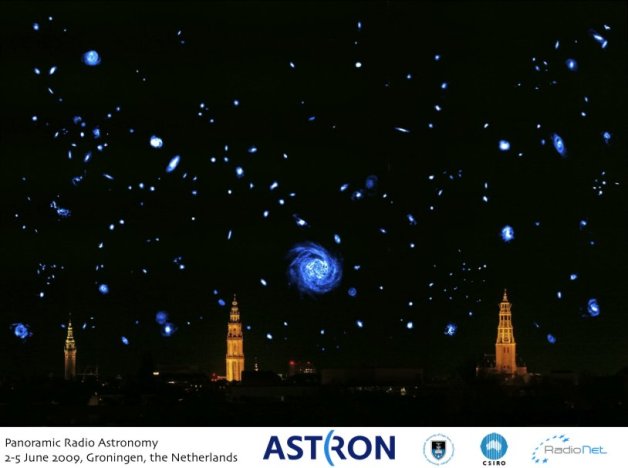
| Introduction |
|---|
|
Panoramic Radio Astronomy
|
| Session 1: New telescope facilities |
|
Panoramic Surveys of the Radio Sky with the Australian SKA Pathfinder
|
|
The EVLA: Progress and Prospects
|
|
The MeerKAT SKA precursor telescope
|
|
The Allen Telescope Array: The First Widefield, Panchromatic, Snapshot Radio Camera
|
|
The latest on Apertif
|
| Session 2: HI Surveys |
|
HI Science with MeerKAT
|
|
NIBLES: an HI census of SDSS galaxies in the Local Volume
|
|
Neutral Hydrogen in Galaxies from Low to High Redshift
|
|
HI Surveys with APERTIF
|
|
Blind Wide Area Surveys: Where will we find redshifted atomic and molecular absorption?
|
|
21cm absorbers at low and intermediate redshifts
|
|
The future of the HI mass function
|
|
A Widefield ASKAP L-band Legacy All-Sky Blind Survey
|
|
Exploring the HI Universe with ASKAP
|
|
HI in radio galaxies
|
|
Evolution of Neutral Gas in Galaxies over Cosmic Time with SKA pathfinder instruments
|
| Session 3: Posters |
|
Preparing old and recent radio source tables for the VO age: Current status
|
|
Low-column density gas in the halo of the Milky Way
|
|
Detection of Submillimetre Galaxies in the Lockman Hole using the European VLBI Network
|
|
Deep wide field HI imaging of M31
|
|
Deep, wide-field global VLBI observations of the HDF-N and HFF
|
|
Properties and short-time evolution of nearby galaxies
|
|
Westerbork ultra-deep HI imaging of galaxy clusters at z=0.2
|
|
Synthetic Observations of the HI Line in SPH-Simulated Spiral Galaxies
|
|
A panoramic view of the Milky Way HI gas
|
|
Properties of the extremely HI-massive galaxy HIZOA J0836-43
|
|
The ATLAS Survey of the CDFS and ELAIS-S1 Fields
|
|
The Far-Infrared Radio Correlation at High-z: Prospects for the SKA
|
|
Star formation and dust obscuration at z ~ 2: galaxies at the dawn of downsizing
|
|
The Ophiuchus Superbubble: Disk-Halo Interaction at Work
|
|
MeerKAT Configuration Studies
|
| Session 4: Continuum surveys |
|
Overcoming the challenges of wide deep continuum surveys
|
|
The E-FIRST Survey, What Comes Next
|
|
Tracing High Redshift Starformation in the Current and Next Generation of Radio Surveys
|
|
The AGN component in radio deep fields: the First Look Survey
|
|
OH MM activity and the ULIRG - SMG source population
|
|
Deep multi-frequency radio imaging in the Lockman Hole using the GMRT and VLA
|
|
The deep Swire VLA field: faint radio populations
|
|
Continuum Surveys with LOFAR
|
| Session 5: Data characterization |
|
Parametrising spatially resolved H I disks
|
|
HI Disks in the high-redshift Universe; Size and Quantified Morphology
|
|
Data reduction strategy of the Effelsberg-Bonn HI Survey (EBHIS)
|
|
Wide-field VLBI observations of 96 radio sources in the Extended Chandra Deep Field South
|
| Session 6: Magnetic Fields and Cosmic Rays |
|
Evolution of magnetic fields in galaxies
|
|
Magnetic fields in nearby galaxies: Prospects with future radio telescopes
|
|
Magnetic fields in nearby galaxies
|
|
Cosmological evolution of magnetic fields in galaxies: future tests with the SKA
|
|
Radio spectral index images of the spiral galaxies NGC 0628, NGC 3627, and NGC 7331
|
| Session 7: Environment, Clusters, and Voids |
|
Gas accretion onto galaxies: models vs past and future observations
|
|
Our changing view of the blue compact dwarf NGC 2915
|
|
The Environmental Impact on Galaxy Evolution: Highlighting the Structure of the Local Cosmic Web
|
|
The relationship between gas and star-formation in galaxies over cosmic history
|
|
HI in Void Galaxies: probing the lowest density environments
|
|
An H I view of the on-going assembly of early-type galaxies: present and future observations
|
|
Radio Properties of Brightest Cluster Members
|
| Session 8: Looking forward |
|
The Square Kilometre Array
|
| Session 9: OH |
|
OH masers in nearby galaxies
|
|
Tracing the merger rate of the Universe with Apertif and ASKAP
|
| Session 10: Complementary single-dish work |
|
Extragalactic HI surveys with ALFA
|
|
The Effelsberg Bonn HI Survey EBHIS
|
| Session 11: The multi-wavelength picture |
|
Synergies with multi-wavelength surveys
|
|
A Somewhat Lower Frequency View of the Chandra Deep Field South
|
|
Galaxy transformation in dense environments: A multi-wavelength study of superclusters at z ~ 0.1-0.5
|
| Session 12: Conference summary |
|
PRA2009: Conference Summary
|
