Parallelizing particle track simulations in gas based charged particle detectors
S. Malhotra* and
O. Bouhali*: corresponding author
Pre-published on:
January 29, 2025
Published on:
April 29, 2025
Abstract
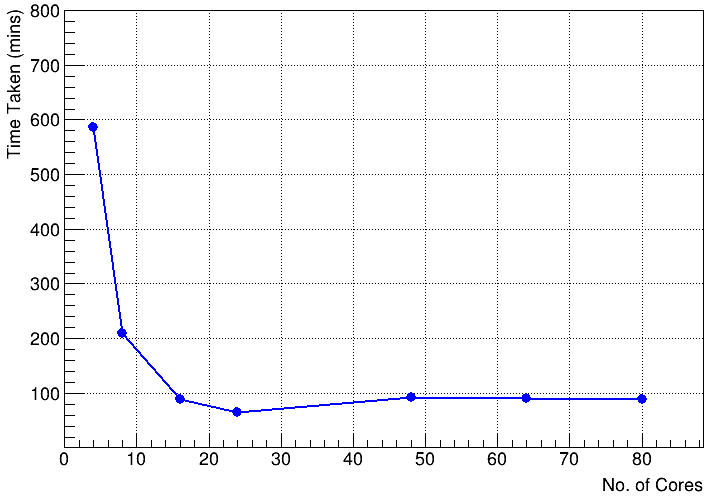
Micropattern Gaseous Detectors (MPGDs) rely heavily on the simulation of the particle passage as conducting these studies allows scientists to cut huge costs and development for prototyping. Even though Garfield++ is a very important part of the simulation of MPGDs, it is very comprehensively intensive particularly when large detector volumes and high gas gains are required. In order to mimic the interaction of relativistic particles through gaseous detectors, High Energy Electro-Dynamic (HEED) photo absorption ionisation (PAI) model was added in the parallel Garfield toolkit (pGarfield). Thus, the whole track of an ionising particle through a detector was simulated with the help of the new pGarfield/HEED implementation. The results will illustrate how parallelization reduced the amount of time and CPU power required for computation of the full simulation.
DOI: https://doi.org/10.22323/1.476.1031
How to cite
Metadata are provided both in
article format (very
similar to INSPIRE)
as this helps creating very compact bibliographies which
can be beneficial to authors and readers, and in
proceeding format which
is more detailed and complete.


 Copyright owned by the author(s) under the term of the Creative Commons Attribution-NonCommercial-NoDerivatives 4.0 International License.