An Augmented QCD Phase Portrait: Mapping Quark-Hadron Deconfinement for Hot, Dense, Rotating Matter under Magnetic Field
G. Mukherjee*,
D. Dutta and
D.K. Mishra*: corresponding author
Pre-published on:
December 17, 2024
Published on:
April 29, 2025
Abstract
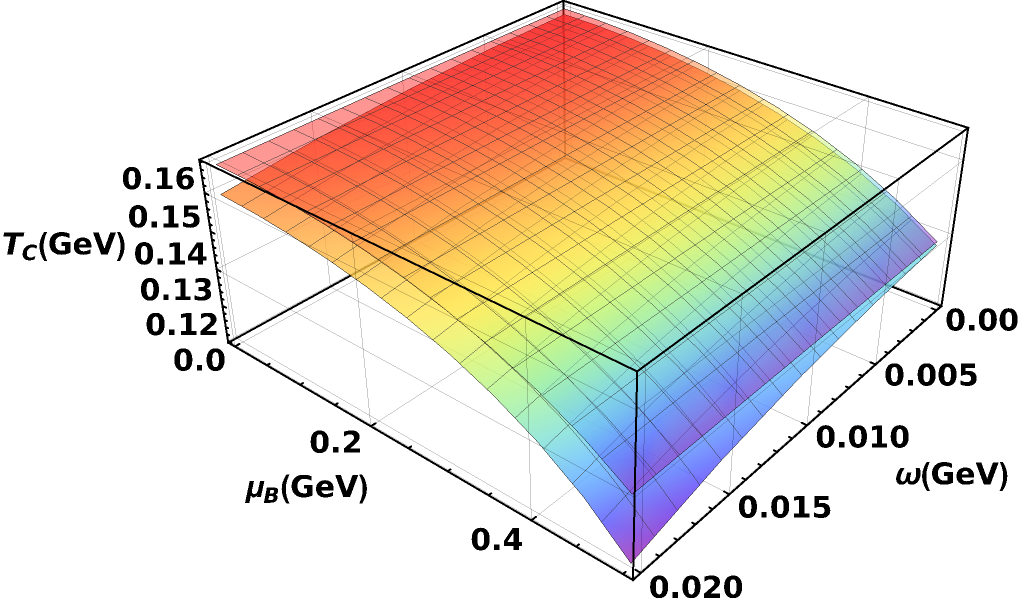
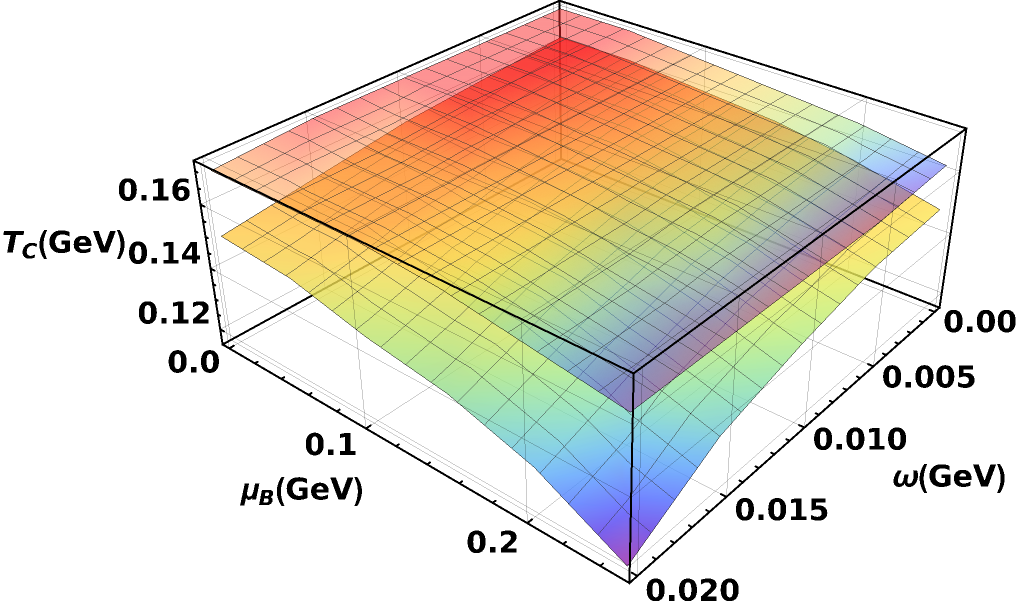
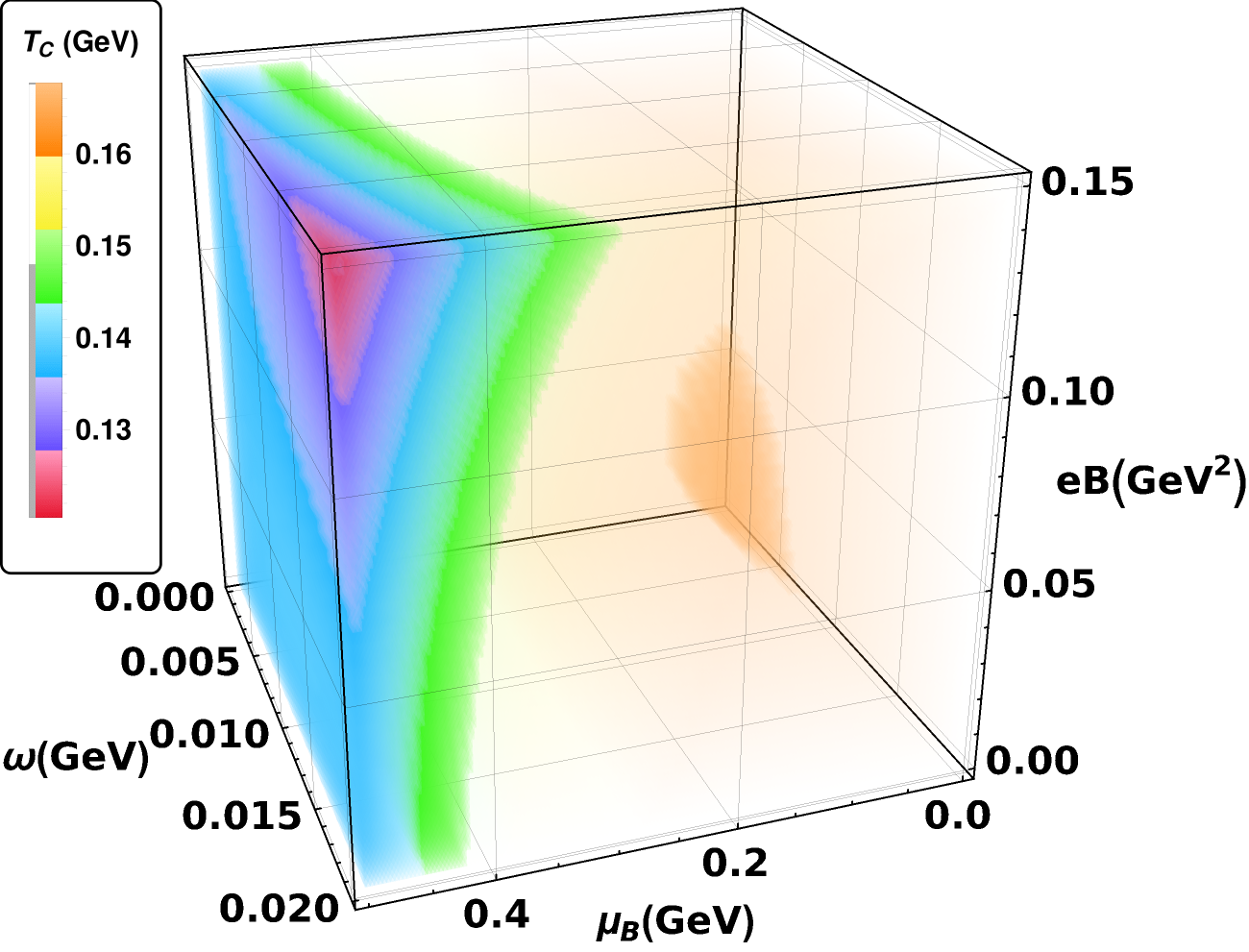
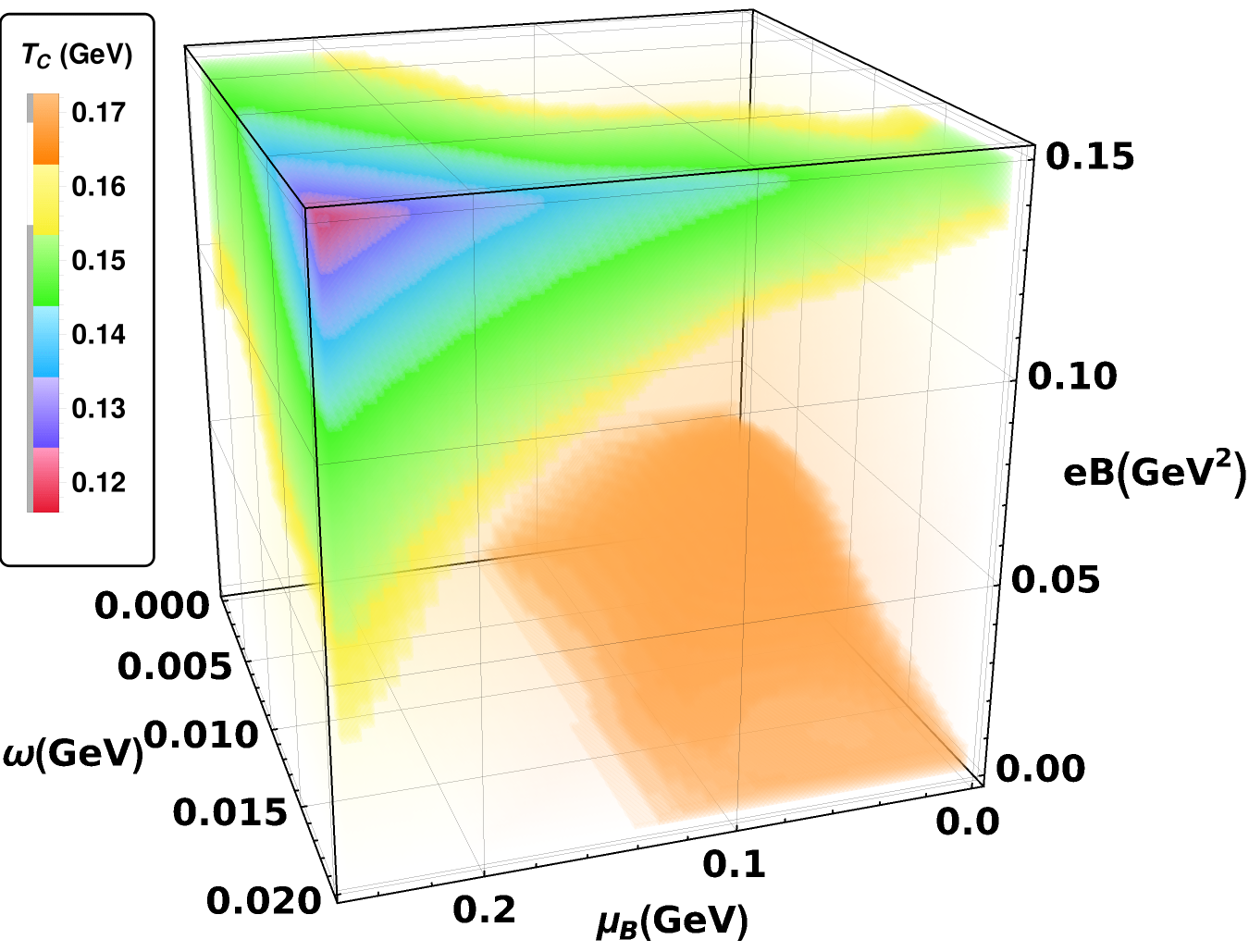
QCD matter under extreme conditions prevailed in the microseconds-old universe and is created in ultra-relativistic heavy-ion collisions. In a generic non-central high-energy nucleus-nucleus collision the overlap region becomes a fireball of quark-gluon plasma (QGP) that sustains strong vorticity due to the finite impact parameter arising from the geometry of the collision and the resultant deposition of angular momentum. This QGP droplet may also be embedded in very powerful magnetic fields sourced initially by the spectator protons of the colliding nuclei and likely sustained or reinforced due to the conductivity and swirling charges of the QGP medium. This motivates the extension of the conventional ($T$--$\mu_B$) planar phase diagram for QCD matter by augmenting it into a multi-dimensional domain spanned by temperature ($T$), baryon chemical potential ($\mu_B$), external magnetic field ($B$) and angular velocity ($\omega$). Using two independent routes, one from a rapid rise in scaled entropy density and another dealing with a dip in the squared speed of sound, we identify the confinement-deconfinement transition in the framework of a modified statistical hadronization model. We find that this approach yields an estimate of the deconfinement temperature $T_C(\mu_B,~\omega,~eB)$ that is found to decrease with increasing $\mu_B,~\omega$ and $eB$ with the most prominent drop (by nearly $40$ to $50$ MeV) in $T_C$ occurring when all the three quasi-control (dependent on collision energy, centrality class, etc.) parameters are tuned simultaneously to finite values that are achievable in present and upcoming heavy-ion colliders. Potentially important magneto-rotational consequences on quark-hadron phenomenology are outlined including a proposal to reinterpret freeze-out data from peripheral collisions and use this as a `magnetometer' and `anemometer' probe.
DOI: https://doi.org/10.22323/1.476.0627
How to cite
Metadata are provided both in
article format (very
similar to INSPIRE)
as this helps creating very compact bibliographies which
can be beneficial to authors and readers, and in
proceeding format which
is more detailed and complete.


 Copyright owned by the author(s) under the term of the Creative Commons Attribution-NonCommercial-NoDerivatives 4.0 International License.