


After the long interruption of the Mondello Workshops series due to the Covid-19 Pandemic, we were finally able to restart this historic series in complete safety.
This is the fifth edition of the series of Mondello Workshops on “Frontier Research in Astrophysics” which is undoubtedly a largely accepted biennial meeting during even years in which an updated experimental and theoretical panorama will be depicted.
After the excellent results obtained during the 2014, 2016, 2018 and 2024 editions we have had the confirmation that the biennial cadence of the Mondello Workshop is the most appropriate.
These meetings are alternated during odd-numbered years by the older series of the workshops dedicated to the Frascati Workshops “Multifrequency Behaviors of High-Energy Cosmic Sources”, to the Palermo Workshops “The Golden Age of Cataclysmic Variables and Related Objects”, and “Accretion Processes in Cosmic Sources”, which have reached the XIV, VI, and II editions, respectively
This Mondello Workshop 2026 edition comes at the forty-second anniversary of the first historical "multifrequency" workshop about "Multifrequency Behaviour of Galactic Accreting Sources", held in Vulcano (Eolian Islands Archipelago) in September 1984. This surely renders our Workshop Series the oldest among the many devoted to "Multifrequency Studies of Cosmic Sources".
Aim of the Workshop:
The purpose of this international workshop is to bring together astrophysicists and physicists who are involved in various topics at the forefront of modern astrophysics and particle physics.The workshop will discuss the most recent experimental and theoretical results in order to advance our understanding of the physics governing our Universe. To accomplish the goals of the workshop, we believe it is necessary to use data from ground-based and space-based experiments and results from theoretical developments: work on the forefront of science which has resulted (or promises to result in) high-impact scientific papers.
Hence, the main purpose of the workshop is to discuss in a unique and collaborative setting a broad range of topics in modern astrophysics, from the Big Bang to Planets and Exoplanets. We believe that his can provide a suitable framework for each participant who (while obviously not involved in all the topics discussed), will be able to acquire a general view of the main experimental and theoretical results
currently obtained. Such an up-to-date view of the current research on cosmic sources can help guide future research projects by the participants, and will encourage collaborative efforts across various topical areas of research.
The publication of the proceedings in Proceedings of Science-SISSA (PoS-SISSA) – a refereed journal – will provide a powerful resource for all the scientific community and will be especially helpful for PhD students.
The following items will be reviewed:
– Cosmology: Cosmic Background, Dark Matter, Dark Energy, Clusters of Galaxies.
– Physics of the Diffuse Cosmic Sources.
– Physics of Cosmic Rays.
– Physics of Discrete Cosmic Sources.
– Extragalactic Sources: Active Galaxies, Normal Galaxies, Gamma-Ray Bursts.
– Galactic Sources: Star Formation, Pre-Main-Sequence and Main-Sequence Stars, the Sun,
Cataclysmic Variables and Novae, Supernovae and SNRs, X-Ray Binary Systems, Pulsars,
Black Holes, Gamma-Ray Sources, Nucleosynthesis, Asteroseismology.
– Gravitational waves: Theory Vs Experiments.
– Planetology: Solar System, Sun-like Stars, Exoplanets.
– Science from large area multiwavelength surveys and deep-exposure pointings.
– Future Physics and Astrophysics: Ongoing and Planned Ground- and Space-based Experiments.
– Machine Learning and Artificial Intelligence applied to the enormous bodies of data made available in the context of Multifrequency Behaviour of High Energy Cosmic Sources.
The workshop will include some 30-minute general review talks to introduce the current problems, and 20-minute talks to discuss new experimental and theoretical results.
A series of 15-minute talks will discuss the ongoing and planned ground-based and space-based experiments.
There will also be some general talks about the future directions of scientific research
on cosmic sources.
The location of the workshop is the Splendid Hotel La Torre, located in Mondello beach
in Palermo, Italy, a venue that will provide a friendly and collaborative atmosphere.
The workshop will be held biennially in even years. This is the fifth edition.
Since the number of participants is limited to about 80 people, I will be grateful in knowing as soon as possible your answer, I hope positive, via E-Mail, and not later than February 28, 2026.
Participation in the workshop is by invitation only from the SOC.
However, to keep alive the workshop it was decided that all presentations should be compulsorily given to the LOC, so that they can be inserted into the web page of the workshop. These presentations will form the basis for writing the papers to be published in the proceedings of the Mondello Workshop 2026 in electronic form by the Proceedings of Science (PoS-SISSA), after a peer referee process, and they will be freely available at once in the NASA-ADS. The editor of the proceedings will be Franco Giovannelli.
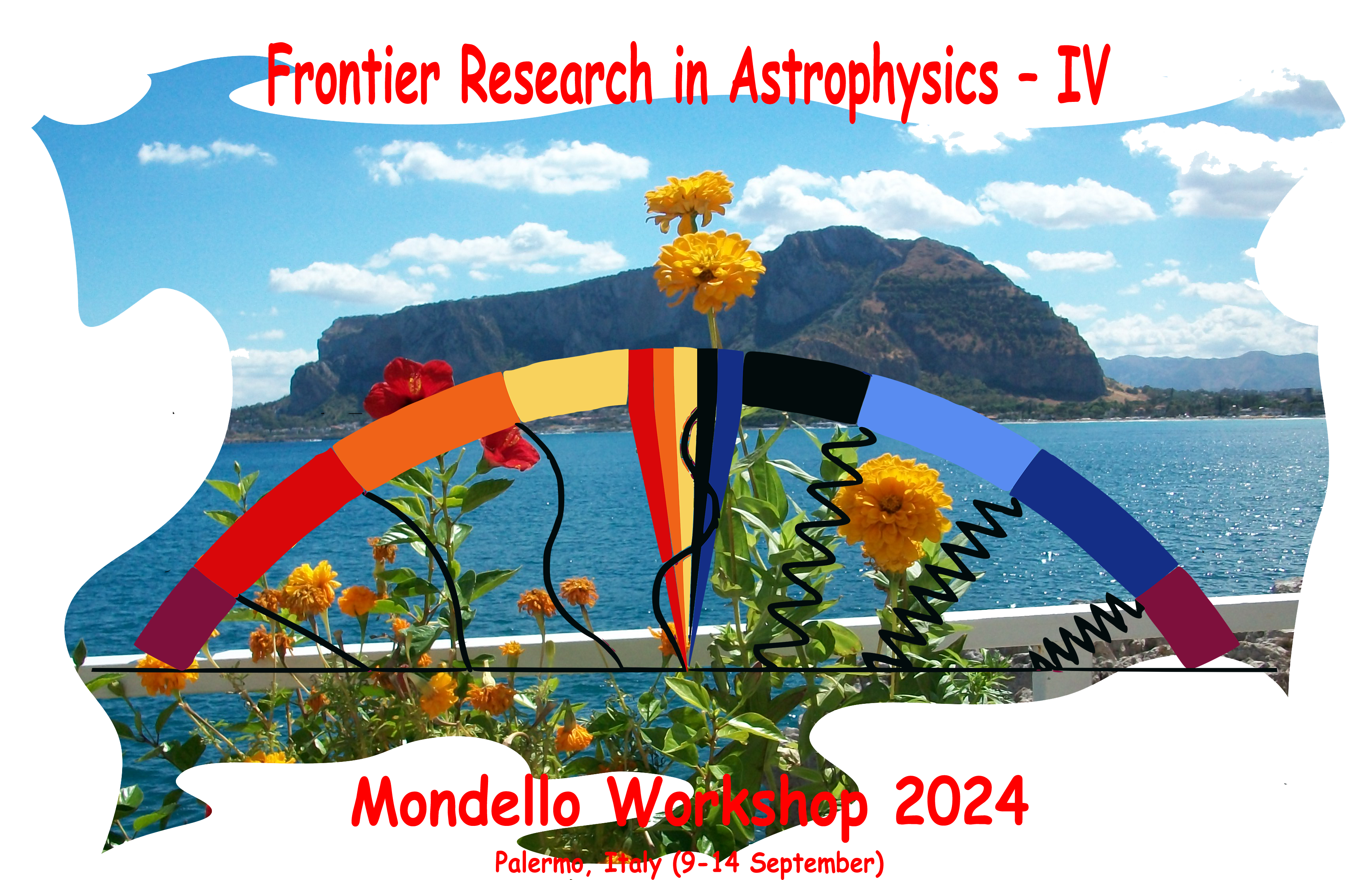
After the long interruption of the Mondello Workshops series due to the Covid-19 Pandemic, we are finally able to restart this historic series in complete safety.
This is the fourth edition of the series of Mondello Workshops on "Frontier Research in Astrophysics" which is undoubtedly a largely accepted biennial meeting during even years in which an updated experimental and theoretical panorama will be depicted.
After the excellent results obtained during the 2014, 2016 and 2018 editions we have had the confirmation that the biennial cadence of the Mondello Workshop is the most appropriate.
These meetings are alternated during odd-numbered years by the older series of the workshops dedicated to the Frascati Workshops “Multifrequency Behaviour of High-Energy Cosmic Sources”, and to the Palermo Workshops “The Golden Age of Cataclysmic Variables and Related Objects”, which have reached the XIV and VI editions respectively.
This Mondello Workshop 2024 edition comes at the 40h anniversary of the first historical "multifrequency" workshop about "Multifrequency Behaviour of Galactic Accreting Sources", held in Vulcano (Archipelago of the Eolian Islands) in September 1984. This surely renders our Workshop Series the oldest among the many devoted to "Multifrequency Studies of Cosmic Sources".
The purpose of this international workshop is to bring together astrophysicists and physicists who are involved in various topics at the forefront of modern astrophysics and particle physics, considering also the recent detection of gravitational waves from the merging of collapsed objects.
The workshop will discuss the most recent experimental and theoretical results in order to advance our understanding of the physics governing our Universe. To accomplish the goals of the workshop, we believe it is necessary to use data from ground-based and space-based experiments and results from theoretical developments: work on the forefront of science which has resulted (or promises to result in) high-impact scientific papers. Hence, the main purpose of the workshop is to discuss in a unique and collaborative setting a broad range of topics in modern astrophysics, from the Big Bang to Planets and Exoplanets. We believe that this can provide a suitable framework for each participant who (while obviously not involved in all the topics discussed) will be able to acquire a general view of the main experimental and theoretical results currently obtained.
Such an up-to-date view of the current research on cosmic sources can help guide future research projects by the participants, and will encourage collaborative efforts across various topical areas of research. The proceedings will be published in Proceedings of Science (PoS)- SISSA and will provide a powerful resource for all the scientific community and will be especially helpful for PhD students.
The following items will be reviewed:
• Cosmology: Cosmic Background Dark Matter, Dark Energy, Clusters of Galaxies.
• Physics of the Diffuse Cosmic Sources.
• Physics of Cosmic Rays.
• Physics of Discrete Cosmic Sources.
• Extragalactic Sources: Active Galaxies, Normal Galaxies, Gamma-Ray Bursts.
• Galactic Sources: Star Formation, Pre-Main-Sequence and Main-Sequence Stars, the Sun, Cataclysmic Variables and Novae, Supernovae and SNRs,
X-Ray Binary Systems, Pulsars, Black Holes, Gamma-Ray Sources, Nucleosynthesis, Asteroseismology.
• Planetology: Solar System, Sun-like Stars, Exoplanets.
• Science from large area multiwavelength surveys and deep-exposure pointings.
• Future Physics and Astrophysics: Ongoing and Planned Ground- and Space-based Experiments.
The workshop will include a few 30-minute general review talks to introduce the current problems, and 20-minute talks to discuss new experimental and theoretical results. A series of 15-minute talks will discuss the ongoing and planned ground- based and space-based experiments.
There will also be some general talks about the future directions of scientific research on cosmic sources for giving the actual prospects for the first decades of this millennium.
The papers will pass a peer-review process and the workshop proceedings will be edited by Franco Giovannelli.
The location of the workshop is the Splendid Hotel La Torre, located in Mondello beach in Palermo, Italy, a venue that will provide a friendly and collaborative atmosphere.
Participation is by invitation only.

As we announced four years ago, the workshop will be held biennially in even years, starting on 2014.
After the excellent results obtained during the 2014 and 2016 editions we have had the confirmation that the biennial cadence of the Mondello Workshop is the most appropriate.
The purpose of this international workshop is to bring together astrophysicists and physicists who are involved in various topics at the forefront of modern astrophysics and particle physics. The workshop will discuss the most recent experimental and theoretical results in order to advance our understanding of the physics governing our Universe. To accomplish the goals of the workshop, we believe it is necessary to use data from ground-based and space-based experiments and results from theoretical developments: work on the forefront of science which has resulted (or promises to result in) high-impact scientific papers. Hence, the main purpose of the workshop is to discuss in a unique and collaborative setting a broad range of topics in modern astrophysics, from the Big Bang to Planets and Exoplanets. We believe that this can provide a suitable framework for each participant who (while obviously not involved in all the topics discussed) will be able to acquire a general view of the main experimental and theoretical results currently obtained. Such an up-to-date view of the current research on cosmic sources can help guide future research projects by the participants, and will encourage collaborative efforts across various topical areas of research. The proceedings will be published in Proceedings of Science (PoS)- SISSA and will provide a powerful resource for all the scientific community and will be especially helpful for PhD students.
The following items will be reviewed.
Cosmology: Cosmic Background, Dark Matter, Dark Energy, Clusters of Galaxies.
Physics of the Diffuse Cosmic Sources.
Physics of Cosmic Rays.
Physics of Discrete Cosmic Sources.
Extragalactic Sources: Active Galaxies, Normal Galaxies, Gamma-Ray Bursts.
Galactic Sources: Star Formation, Pre-Main-Sequence and Main-Sequence Stars, the Sun, Cataclysmic Variables and Novae, Supernovae and SNRs, X-Ray Binary Systems, Pulsars, Black Holes, Gamma-Ray Sources, Nucleosynthesis, Asteroseismology.
Planetology: Solar System, Sun-like Stars, Exoplanets.
Science from large area multiwavelength surveys and deep-exposure pointings.
Future Physics and Astrophysics: Ongoing and Planned Ground- and Space-based Experiments.
The workshop will include a few 30-minute general review talks to introduce the current problems, and 20-minute talks to discuss new experimental and theoretical results. A series of 15-minute talks will discuss the ongoing and planned ground-based and space-based experiments. There will also be some general talks about the future directions of scientific research on cosmic sources. The papers will pass a peer-review process and the workshop proceedings will be edited by Franco Giovannelli & Lola Sabau-Graziati.
The location of the workshop is the Splendid Hotel La Torre, located in Mondello beach in Palermo, Italy, a venue that will provide a friendly and collaborative atmosphere.
Participation is by invitation only.

The purpose of this international workshop is to bring together astrophysicists and physicists who are involved in various topics at the forefront of modern astrophysics and particle physics. The workshop will discuss the most recent experimental and theoretical results in order to advance our understanding of the physics governing our Universe. To accomplish the goals of the workshop, we believe it is necessary to use data from ground-based and space-based experiments and results from theoretical developments: work on the forefront of science which has resulted (or promises to result in) high-impact scientific papers. Hence, the main purpose of the workshop is to discuss in a unique and collaborative setting a broad range of topics in modern astrophysics, from the Big Bang to Planets and Exoplanets. We believe that this can provide a suitable framework for each participant who (while obviously not involved in all the topics discussed), will be able to acquire a general view of the main experimental and theoretical results currently obtained. Such an up-to-date view of the current research on cosmic sources can help guide future research projects by the participants, and will encourage collaborative efforts across various topical areas of research. The proceedings will be published in Proceedings of Science (PoS)- SISSA and will provide a powerful resource for all the scientific community and will be especially helpful for PhD students.
The following items will be reviewed:
Cosmology: Cosmic Background, Dark Matter, Dark Energy, Clusters of Galaxies.
Physics of the Diffuse Cosmic Sources.
Physics of Cosmic Rays.
Physics of Discrete Cosmic Sources.
Extragalactic Sources: Active Galaxies, Normal Galaxies, Gamma-Ray Bursts.
Galactic Sources: Star Formation, Pre-Main-Sequence and Main-Sequence Stars, the Sun, Cataclysmic Variables and Novae, Supernovae and SNRs, X-Ray Binary Systems, Pulsars, Black Holes, Gamma-Ray Sources, Nucleosynthesis, Asteroseismology.
Planetology: Solar System, Sun-like Stars, Exoplanets.
Science from large area multiwavelength surveys and deep-exposure pointings.
Future Physics and Astrophysics: Ongoing and Planned Ground- and Space-based Experiments.
The workshop will include a few 35-minute general review talks to introduce the current problems, and 20-minute talks to discuss new experimental and theoretical results. A series of 15-minute talks will discuss the ongoing and planned ground-based and space-based experiments. There will also be some general talks about the future directions of scientific research on cosmic sources. The papers will pass a peer-review process and the workshop proceedings will be edited by Franco Giovannelli & Lola Sabau-Graziati.
The location of the workshop is the Splendid Hotel La Torre, located in Mondello beach in Palermo, Italy, a venue that will provide a friendly and collaborative atmosphere.

The following items will be reviewed:
Cosmology: Cosmic Background, Dark Matter, Dark Energy, Clusters of Galaxies
Physics of the Diffuse Cosmic Sources
Physics of Cosmic Rays
Physics of Discrete Cosmic Sources
Extragalactic Sources: Active Galaxies, Normal Galaxies, Gamma-Ray Bursts
Galactic Sources: Star Formation, Pre-Main-Sequence and Main-Sequence Stars, Cataclysmic Variables and Novae, Supernovae and SNRs, X-Ray Binary Systems, Pulsars, Black Holes, Gamma-Ray Sources, Nucleosynthesis.
Future Physics and Astrophysics: Ongoing and Planned Ground- and Space-based Experiments
The workshop will include few 40-minute general review talks to introduce the current problems, and typically 20-minute talks discussing new experimental and theoretical results. A series of 15-minute talks will discuss the ongoing and planned ground- and space-based experiments.
The cadence of the workshop will be biennial. The participation will be only by invitation.
Editors: Franco Giovannelli and Lola Sabau-Graziati