In this paper, we study the phenomenology of the charm and beauty content of the proton within
the 𝑘𝑡 -factorization formalism, using the integral version of the Kimber-Martin-Ryskin (𝐾𝑀𝑅)
and Martin-Ryskin-Watt (𝑀𝑅𝑊) unintegrated parton distribution functions (𝑈𝑃𝐷𝐹) together
with the angular ordering constraint (𝐴𝑂𝐶). For this purpose, the reduced beauty cross section
𝜎𝑏¯
𝑏
red (𝑥,𝑄2) and the charm and beauty structure functions 𝐹𝑞𝑞¯
2 (𝑥,𝑄2) (𝑞 = 𝑐, 𝑏) are calculated by
the 𝑘𝑡 -factorization formalism using 𝐾𝑀𝑅 and 𝑀𝑅𝑊 approaches and the 𝑀𝑀𝐻𝑇2014-𝑃𝐷𝐹 set
as input. Recently, Guiot and van Hameren demonstrated that the upper limit 𝑘max of the transverse momentum
integration in the 𝑘𝑡 -factorization formalism should be approximately equal to 𝑄, the
hard scale, to avoid overestimating the proton structure function. In the present work, we show
that this condition (𝑘max = 𝑄) is not valid in the low and moderate energy regions. Furthermore,
by considering both gluon and quark contributions at the same perturbative order and employing a
physical gauge for the gluon, i.e., 𝐴𝜇𝑞′
𝜇 = 0, in the calculation of 𝐹𝑞𝑞¯
2 within the 𝑘𝑡 -factorization
formalism, we do not encounter any overestimation of the theoretical predictions for different
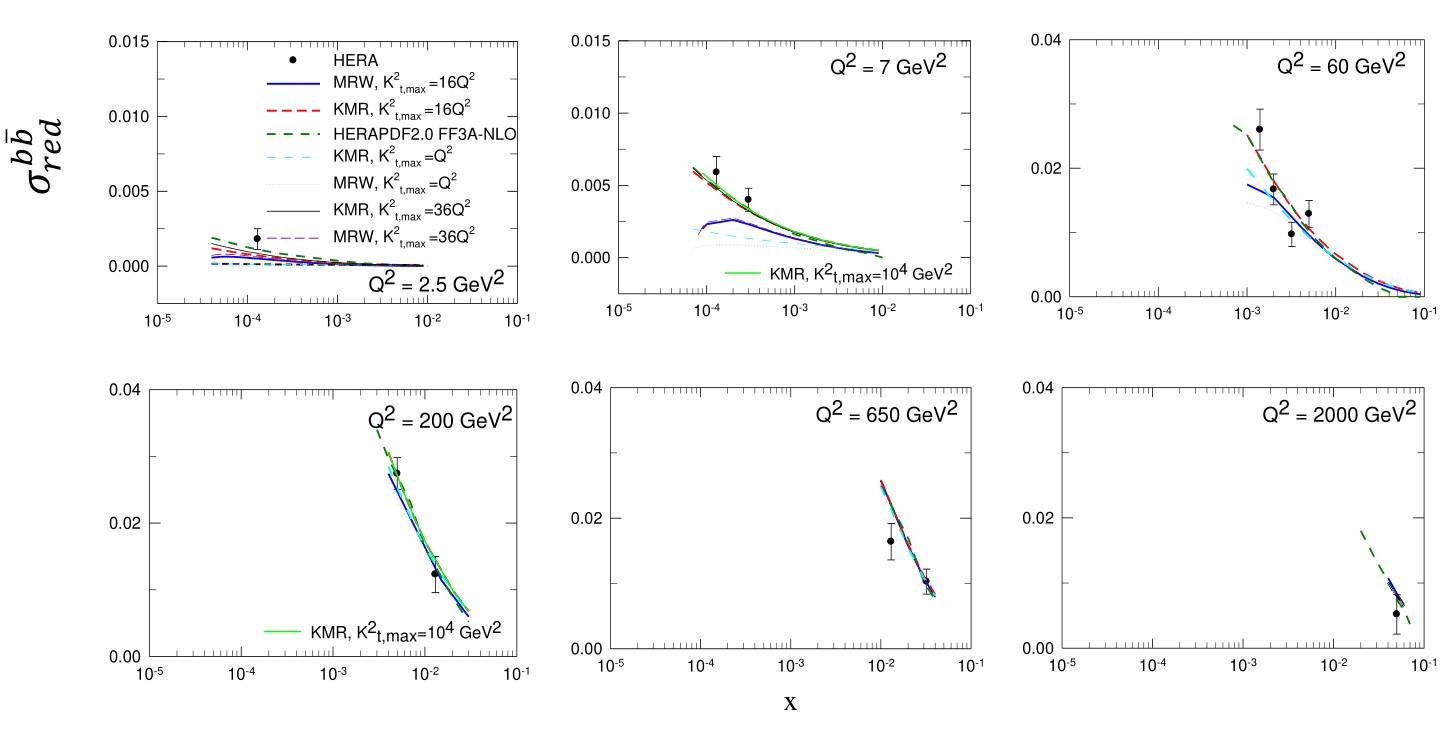
choices of 𝑘max > 𝑄. Finally, the computed values of the reduced beauty cross section, 𝜎𝑏¯𝑏red ,
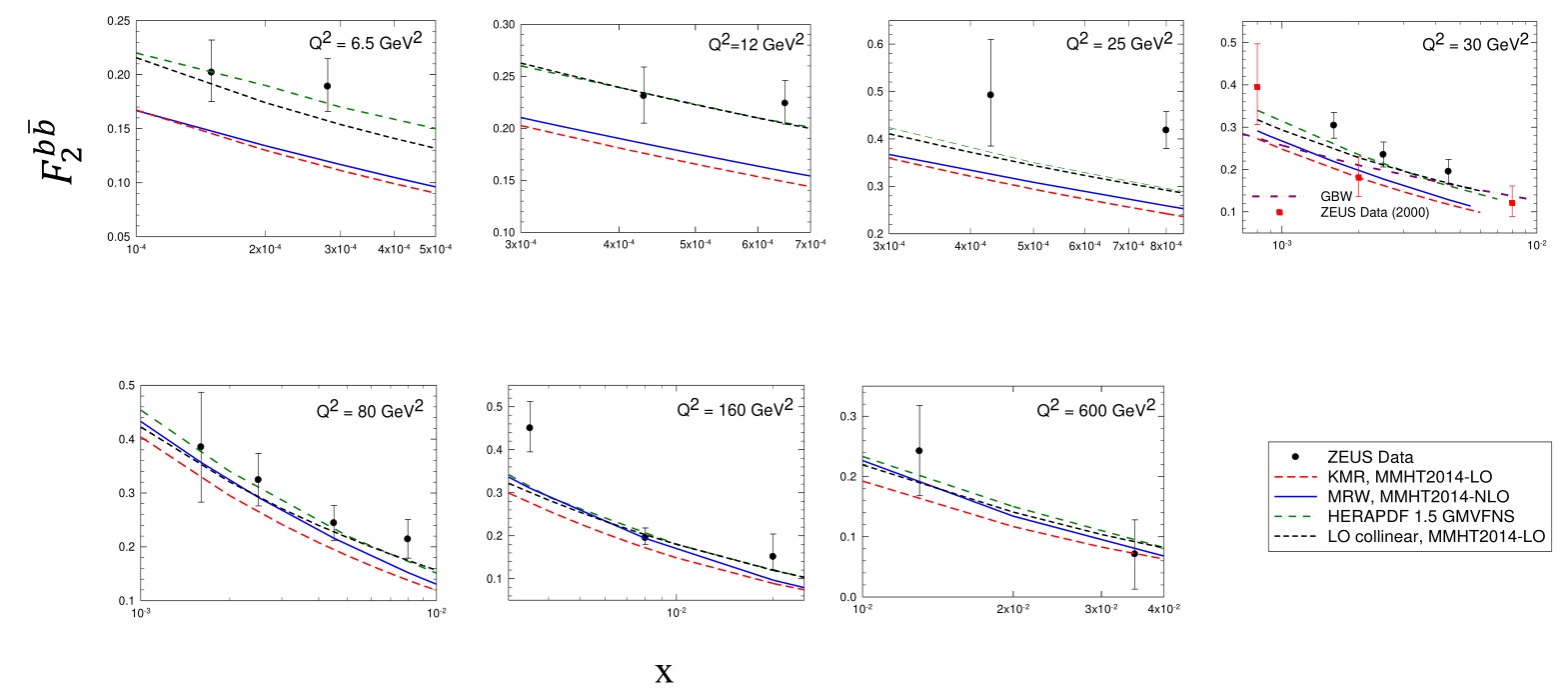
and the charm and beauty structure functions, 𝐹𝑞𝑞¯2 , are compared with the experimental data of the 𝑍𝐸𝑈𝑆 and 𝐻1 collaborations in 𝐻𝐸𝑅𝐴 and theoretical predictions. In general, the results
obtained from both the 𝐾𝑀𝑅 and 𝑀𝑅𝑊 methods are in perfect agreement with the experimental
and theoretical predictions, especially at high energies, but the 𝐾𝑀𝑅 framework is better consistent
with the experimental data and theoretical predictions than the 𝑀𝑅𝑊 framework at the low and
moderate energies.